
This summer and fall, I’ve been on the road a lot more than usual, at conferences and meetings around the country, with people across psychedelic, healthcare, and policy circles. The energy building around the future of psychedelic therapy is undeniable. Between the groundbreaking results for safety and effectiveness coming out of the state-regulated programs, exciting progress in clinical trials, and the increasing likelihood of federal approval for some form of prescription access, there’s a shared recognition that real change is happening, and everyone is working out how to prepare.
For Healing Advocacy, that means doubling down on our commitment to help more people, across more pathways, reach the transformative care they deserve.
In Oregon, Colorado, and New Mexico, we’ve partnered with policymakers, providers, and people seeking care to build safe, effective, accessible programs — ones that have helped more than 25,000 people already and will continue to be critical to the mission of bringing this healing to all who can benefit.
Now, as psychedelic medicine integrates ever more into existing healthcare, new pathways for access will come into play. New expertise will come to the table, particularly when it comes to navigating the complexities of the healthcare system.
Healing Advocacy works for the people who need this care. We’ve developed a lot of real-world experience about what works well, how to balance safety and access, and how to help policymakers and regulators problem-solve the challenges that inevitably arise.
But we recognize the value of collaborating with the deep technical expertise that already exists in healthcare, even as we question “how it’s always been done” to make sure patients’ needs stay at the center of the work. We feel fortunate for the incredible partners in both the psychedelic and broader mental health fields who are stepping up on Medicaid, private insurance, hospital system integration, scopes of work, billing codes, and all the other critical details of this undertaking.
In the details and the mission, our guiding light will always be whether people can actually get the care that has already changed so many lives. People like Jessica, a trauma survivor who told us how her psilocybin therapy experience in Oregon transformed her life:
“It has helped me understand and navigate life in radically different ways that have helped me get out of severely harmful situations, heal from them, find a healthier life, and become a version of myself I couldn't even imagine.”
How do we keep making stories like this one possible, as safely, effectively, and accessibly as we can? We look forward to working with the whole field to build the answer to that question, and bring healing to all the people who need it.
With Gratitude,
Taylor West
Executive Director
P.S. If you or someone you know has a story to share about psychedelic healing, we’d love to hear it. You can share it through our story collection form.
UPDATES: NATIONAL
Know a Faculty Member Who Should Be Teaching About Psychedelic Medicine?
Applications are now open for the 2027 Faculty Fellowship from the University Psychedelic Education Program (U-PEP), a philanthropically funded initiative that helps health professions faculty bring evidence-based psychedelic content into their own curricula. The fellowship is free to full-time faculty at U.S. accredited schools of nursing, social work, medicine, psychology, counseling, physician assistant/associate, and public health. Selected Fellows receive a 4-day Faculty Education Program at Usona Institute in summer 2027, one-on-one curriculum mentorship, access to a shared resource hub and network of subject matter experts, monthly learning sessions, and an immersive retreat at 1440 Multiversity in November 2027. They also join a national community of more than 185 Fellows from 70 institutions across 35 states, Washington D.C., and Puerto Rico. Applications close December 6, 2026.
> Learn more and apply
UPDATES: OREGON
Up to Date Numbers on Psilocybin Services Program Licensing
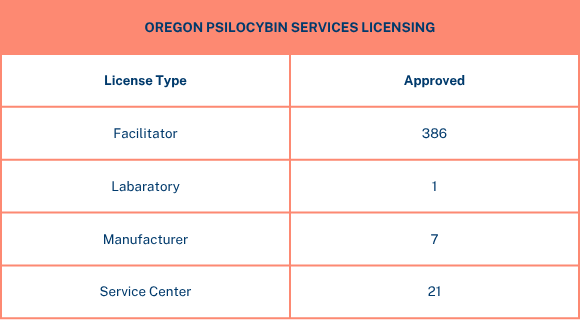
View the Oregon Psilocybin Services Data Dashboard to see the most up-to-date numbers.
Sheri Eckert Foundation's 2027 Oregon Psilocybin Improvement Act
The Sheri Eckert Foundation is moving forward a legislative bill to improve the Oregon Psilocybin Services program. The bill — called the Oregon Psilocybin Services Improvement Act — has been pre-session filed for the 2027 session by Representative Rob Nosse.
Last month, the Oregon Health Authority withdrew its plan to double every license fee in September, after clients, facilitators, operators, and organizations made the case that these fees would damage the program. The Act aims to improve the program for long-term sustainability — cap the license fees in law, write rules and safeguards appropriate to the actual risk profile of psilocybin, cut unnecessary costs, add services at home for the people who need them, and more. Legislative Counsel will return a draft of the bill by December 1. Individuals and organizations can support changes to the program through this bill now by adding their name, as well as proposing other fixes to the program.
Oregon’s Drop Thesis Service Center Creates Free Veteran Program
The Path Forward Program is a veteran-focused initiative developed by Drop Thesis, a licensed psilocybin service center in Bend, Oregon, in partnership with the Returning Veterans Project. It provides veterans with access to legal, professionally facilitated psilocybin experiences in a safe and supportive environment. Each participant receives individualized preparation, a guided psilocybin session, and integration support designed to help them process their experiences and gain new perspectives. The program’s mission is to offer veterans an opportunity for healing, personal growth, and a renewed sense of purpose.
The program is funded through the generosity of local businesses and individuals who sponsor veterans at $3,000 per participant. Contributions are coordinated through the Returning Veterans Project, helping remove financial barriers for veterans who might otherwise be unable to access these services. Drop Thesis has already begun working with its first veterans and is excited to grow this into a lasting, community-supported program. The hope is to bring together local businesses, individuals, and organizations who want to make a meaningful difference in the lives of those who have served. The work was recently covered by KTVZ. Veterans interested in the program can reach out to Kris at Drop Thesis.
UPDATES: NEW MEXICO
Support for Program, Access Concerns in Rulemaking
The October 2 rulemaking hearing in New Mexico drew strong public participation. The state’s draft rules addressed licensure, training and education, and healing center requirements. Dozens of people showed up to give live public comments, and roughly 80 people submitted written comments. Nearly all comments focused on the access barriers created by newly proposed regulations, including a proposed prescriber gateway, landlord authorization requirements for renter-patients, and other draft provisions that will compromise access.
Healing Advocacy’s goal is to work with agency leadership, lawmakers, community members, and other stakeholders to ensure widespread access, protect clinical integrity in the program’s final rules, and ultimately support a successful program.
UNM Psychedelic Research Highlighted Before Health Committee
On October 19th, Healing Advocacy joined researchers and advocates to update the Legislative Health and Human Services Interim Committee of the New Mexico Legislature on the psychedelic clinical research underway at the University of New Mexico. This research includes the Group Psychedelic Assisted Therapy (GPAT) for PTSD pilot, which UNM is carrying out in partnership with the Psychedelic Mental Health Access Alliance, and research focusing on psychedelic treatment for Opioid Use Disorder. The presentation can be viewed online, beginning at the 3:14:00 timestamp.
Laboratory Permits Open
Permits opened this month for laboratories in New Mexico. Permit applications can be accessed online and the associated eligibility and compliance regulations for laboratories can be reviewed here.
Equity Fund Rulemaking Opens for Public Comment
New Mexico’s Treatment Equity Fund, the first program of its kind in the country, is designed to cover the cost of psilocybin treatment for low-income New Mexicans. The Department of Health has published draft rules governing the Fund’s eligibility and application process. Healing Advocacy helped coordinate legislative advocacy earlier this year to secure a $630,000 investment in the Fund.
The draft rules can be seen online. A public hearing will be held in Santa Fe at 9 a.m. on Friday, November 20, 2026. Public comment is accepted on the rules through the hearing date, and those committed to equity and access in the state program are encouraged to participate.
UPDATES: COLORADO
Up to Date Numbers on Natural Medicine Program Licensing
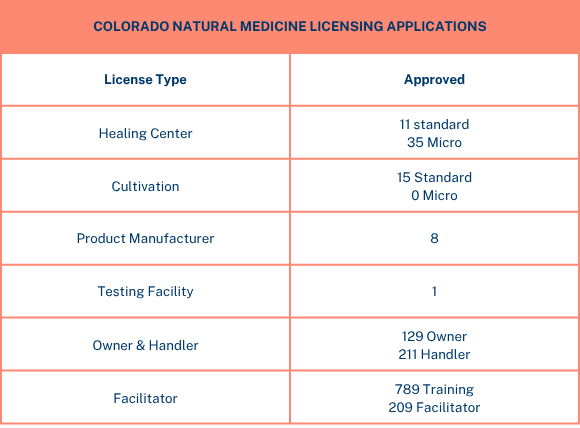
View HA's Healing Center Directory for a list of licensed healing centers in Colorado. You can also search for facilitators using DORA's licensee lookup tool.
Agencies Continue to Evaluate Program Changes
This past month, dozens of stakeholders provided feedback to Colorado regulators as they consider changes to the natural medicine program. Discussion focused on a few core areas:
DOR Temporary Premises Permits
Healing Advocacy proposed this concept to expand access in Colorado’s rural and natural areas, allowing healing centers to apply for temporary permits to host administration sessions at diverse locations without those locations needing to go through the full licensure process. The Department of Revenue (DOR) has made multiple changes to the concept based on feedback from Healing Advocacy and other stakeholders. Under their most recent draft rules, healing centers would pay $1,000 to apply for a permit, plus an additional compliance fee of $500 (for groups of up to 12 participants) or $750 (for groups larger than 12) for each administration session at the permitted location. Unlike healing center licenses, temporary premises permits could be issued to private residences without the requirement for a separate structure or that the residence be unoccupied – which could allow for a greater diversity of settings, including short-term rental properties. Healing Advocacy is planning to request that a third tier be added for groups of 6 participants or less at a rate of $250 per administration session, to increase access in rural areas. Written comments may be submitted through DOR’s Rule Comments Form, and a Final Rulemaking Hearing is scheduled for November 4 at 9:30am (Register Here).
DORA Proposed Changes to Training Requirements
The Department of Regulatory Agencies (DORA) heard feedback on a set of discussion questions regarding training requirements. One big takeaway is that training programs in Colorado are strongly opposed to requiring that 50% of practicum hours take place with community members rather than fellow practicum students. They make a compelling case that practicing facilitation with fellow students first is safer and more ethical than having students jump in the deep end with community members during their first 40 hours of practice. Healing Advocacy proposed a middle ground, where practicum hours may be completed with fellow students, and up to 10 or 15 consultation hours may be completed through observed facilitation sessions with community members. This meeting also included significant discussion around possible changes to the legacy pathway for experienced practitioners to become licensed. DORA is still considering options and has not yet issued proposed rule changes or a formal notice of rulemaking. Listen to the meeting recording for the full discussion.
COMMUNITY SPOTLIGHT
James Blackford: Medicine for More New Mexicans
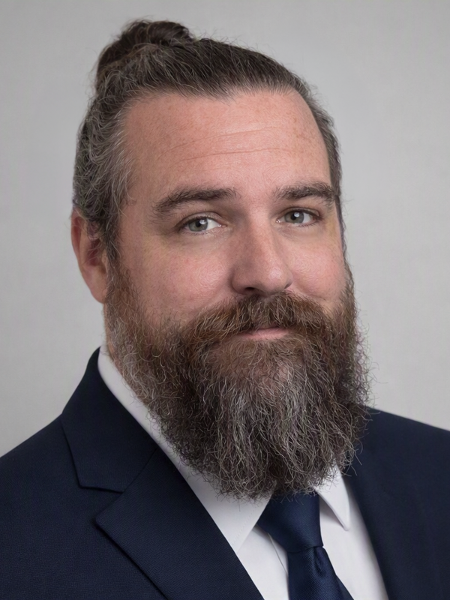
James Blackford is the founder and owner of Sacred Alto Spores, New Mexico’s first licensed psilocybin producer. Raised in Florida by a single mother who worked through chronic pain to support six children, he brings that same perseverance to his work, building his business through nights, weekends, and lunch breaks while keeping up a full-time job as an analyst for business and strategy operations and running calls for his appliance repair business in between. After reading about New Mexico’s SB 219, he borrowed from his 401(k) to launch Sacred Alto Spores, finishing the facility’s build-out himself just 36 hours before his onsite inspection. He lives in New Mexico with his wife, Cat, and their two daughters, who inspire his hope that this work can change lives.
What brought you to open Sacred Alto Spores?
My sister served in the Marines and struggled for years with PTSD, anxiety, and depression. She had a healing experience through psilocybin, and now she's happier than she's ever been. A few months later, I came across a small article about New Mexico's SB 219, which created our state’s medical psilocybin program. I went to my first advisory board cultivator meeting just to listen, and by the end I thought, maybe I could actually do this. The months leading up to my permit were the hardest of my life, and completely worth it. What I've found in this space is people whose whole drive is to help others, and that's what I want to do also.
How does your background shape the way you approach this work?
I grew up one of six kids, raised by a single mother on food stamps and in government-assisted housing. There was a lot of love in our family, but growing up without money left lasting anxieties. Now I have two daughters, 15 and 18, and my motivation is to give them a life where they don't have to struggle to live. I want them to be able to just live and to pursue their passions. My oldest daughter dreams of getting a van and traveling the country, and I love that.
So when I'm working 15-hour days and learning as I go, failure isn't an option. If there's no door, I'll go through a wall. Success to me isn't houses or cars. It's giving the people I love a life where they can enjoy it, not just survive it.
What perspectives do you have on the state program as a representative of rural NM?
New Mexico isn't a wealthy state, and I come from that world. So many people make decisions about their physical and mental health based on money. Even with insurance, they skip the doctor because they can't cover the 20% owed out of pocket. When it comes to mental health, groceries and bills come first, and a lot of people sacrifice themselves for the people they're taking care of. My fear is that people will struggle to access psilocybin when it could change so many lives. I really hope advocates help build that access, because without it, I don't think it will be there for people who don't have the money.
What do people outside New Mexico need to know about the differences in our state and communities and how those differences will impact our program?
I'm so proud that we were the first state to create a medical psilocybin program through the legislature, and I think other states will look to us as an example. New Mexico has only a few big cities, and everything else is spread out. It's a unique landscape with a unique group of people who truly call it home, and people here seem more connected than in places full of big cities. When people as connected as we are share a goal and a purpose, the effect is so much stronger. That's why New Mexico has been successful and will continue to be. There will be places where people aren't as open-minded or informed, but that's an opportunity to educate. This isn't something of the hippies in a '70s movie — there is purpose and intention behind this healing.
If you could tell a future patient one thing before their first session, what would it be?
If you have preconceived notions or even previous experience with psilocybin from experimenting as a young person, know that this may be the same substance, but intention is where the healing lies. Be open-minded, and don't be afraid of what you experience. It lets you look at things from a different perspective and work through them. I learned that myself. My whole life, I was afraid of the dark, which is ironic for a big, burly, tattooed guy. During one intentional session with psilocybin, I was watching the sun go down over the mountains. Before I knew it, it was completely dark, with no lights on, and I felt connected and at peace with everything around me. I haven't been afraid of the dark since.
RESEARCH
“Am I a Candidate for Magic Mushrooms?” A mystery Shopper Study of Oregon Psilocybin Service Centers
A new mystery shopper study published in Health Affairs Scholar offers a rare, firsthand look at how Oregon’s licensed psilocybin service centers actually handle prospective clients with mental health histories. Researchers posed as adults with depression taking an antidepressant, each also disclosing either an alcohol use disorder or a family history of psychosis, and called 15 of Oregon’s 22 active centers. The results suggest the state’s supervised model is working as a safety net as intended: every center screened for active suicidal thoughts, no center recommended stopping an SSRI, and no one offered unsupervised use or same-day dosing without an intake assessment.
> Read the study
EVENTS
CEU Opportunity: Medicaid Coverage in New Mexico’s State Psilocybin Program
Join Healing Advocacy and Psychedelic Mental Health Access Alliance on Friday, December 11 at 12 PM MST for a one-credit-hour virtual CEU on Medicaid coverage in New Mexico’s state psilocybin program. Learn how to secure coverage for the therapeutic components of care, from credentialing to billing and audits. We’ll also address how insurance billing could work in Oregon’s and Colorado’s state-based programs.
Presented by Denali Wilson, Victoria Cvitanovic, and Dr. Anne Metz. Medicaid integration is central to access.
> Register
Webinar: A Conversation with Steven C. Hayes, PhD
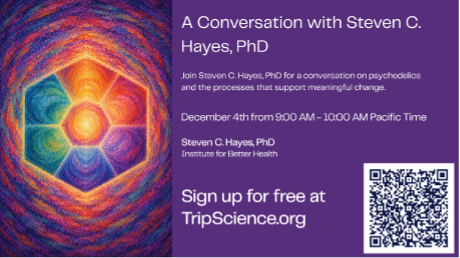
Hosted by TRIPS (Therapy & Research in Psychedelic Science)
Friday, December 4, 2026, 9:00 to 10:00 AM PT, on Zoom
Free registration
Join Dr. Steven C. Hayes, the originator of Acceptance and Commitment Therapy (ACT), for a thoughtful conversation on psychedelics. Rather than a formal presentation, this session is a question-and-answer dialogue exploring how psychedelics relate to mental health, where ACT and psychological flexibility fit into psychedelic-assisted care, and what a process-based lens might offer clinicians working in a field that holds both real promise and real uncertainty.
Whether you’re just beginning to explore psychedelic work or already practicing, this is a chance to slow down and think carefully alongside one of the leading voices in evidence-based therapy.
> Register
Upcoming event: Psychedelic Lived Experiences, November 20-22
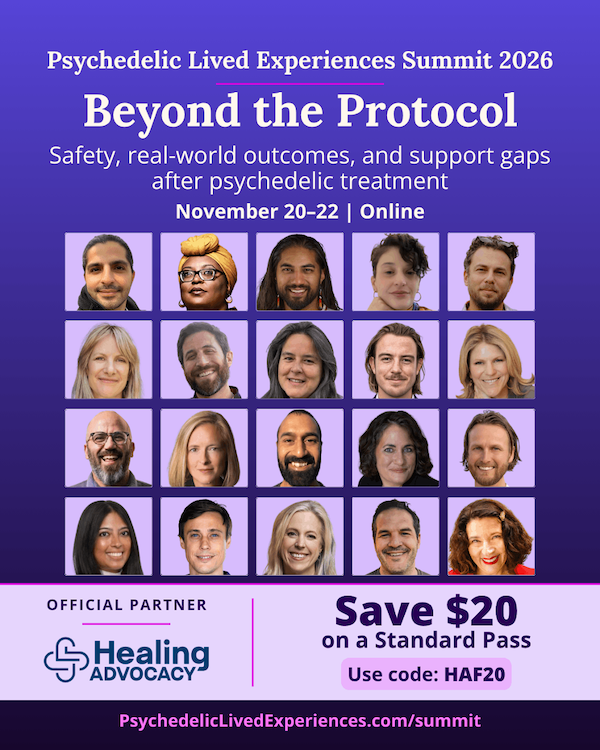
Healing Advocacy is partnering with the Psychedelic Lived Experiences Summit, online November 20–22, 2026. Under the theme Beyond the Protocol, patients, caregivers, clinicians, and researchers will examine safety, real-world outcomes, and support gaps after psychedelic treatment. Registration includes live sessions and recordings. Student passes are $29 USD; scholarship applications close November 1. Use HAF20 for $20 USD off the Standard Pass until November 20, 2026.
> Register
IN THE NEWS
Psilocybin Providers Follow Safety Guidelines, Study Finds
WashU Medicine
“Going in, we wondered whether Oregon’s model might work like a dispensary in practice — that you could call a center, pick up psilocybin and take it home with little screening along the way,” said co-senior author Kevin Xu, MD, an assistant professor of psychiatry at WashU Medicine. “Far from a dispensary model, I was surprised by how service centers asked detailed questions about callers’ mental health and risk factors.”
> Read the full story
Exploring Psilocybin as an Emerging Treatment For CTE
FoxLIVE
Psychotherapist Carolina Correa, founder of Numia Healing, joins LiveNOW from FOX's Ryan Schmelz to discuss emerging treatments for CTE. Correa explores how psilocybin-assisted therapy—currently legal in Colorado and Oregon—could be a breakthrough approach to healing brain trauma in athletes.
>Watch the full story
First Psilocybin Therapy Center in the Pikes Peak Region
Fox21 Colorado Springs
Elevated Healing Center opened in mid-September in Manitou Springs, becoming the first state-licensed psilocybin healing center in the Pikes Peak Region. The facility offers supervised magic mushroom-assisted therapy using the psychedelic compound found in psilocybin mushrooms.
> Watch the full story
Department of Health Holds Hearing on Psilocybin Rules: 'Landlord Issue' Draws Public Concern
SF Reporter
With December as the target for launching legal psilocybin therapy in New Mexico, the state Department of Health held a hearing Friday, Oct. 2, to present draft rules and hear public comment. Public concern centered on a rule that requires patients who rent their homes to get landlord approval for any in-home therapy. Meanwhile, some advocates wonder if the state's December launch isn't too soon.
> Read the full story
New Mexico Medical Psilocybin Program Regulation Changes Spark Outcry
Lucid News
Medical providers, military veterans, legal experts and the primary legislative author of New Mexico’s Medical Psilocybin Act delivered a unified rebuke to the New Mexico Department of Health during an Oct. 2 public rulemaking hearing, warning that newly added administrative mandates threaten to make the state’s landmark psychedelic therapy program inaccessible to its most vulnerable residents.
> Read the full story