
A Big Win in Oregon — and New Momentum for Psychedelic Healing
Last week, the FDA did something it had never done before. It held a full public hearing on the future of psychedelic therapies and invited people from across the country to weigh in.
I listened as dozens of people gave testimony, and I kept coming back to one question - what will this mean for the patients who are waiting for care? At Healing Advocacy, our job is to make sure people seeking care are kept at the center of the policies that will determine how that care gets rolled out. Here’s what stood out to me.
First, the therapeutic container matters. Speaker after speaker made the case that psychedelic therapy, in its most effective form, is about much more than a pill. But I personally think therapist and Colorado-licensed psilocybin facilitator Mikki Vogt said it best: “Healing is rarely the product of a molecule alone. Preparation gives it direction. The therapeutic relationship gives it safety. Integration gives it durability.”
Second, there were real differences of opinion about who should deliver care. Some argued for a strictly medical framework, with care provided only by those holding medical licenses. Others warned that over-medicalizing the care model could create significant bottlenecks in both access and affordability, at a time when many states already face major provider shortages. From where we sit, the answer starts with the patient. Matching each person's needs with the right level of practitioner training and competencies will be central to expanding access, without compromising safety, in the years ahead.
In the end, the hearing reinforced my conviction that we can’t assume this treatment can or should be delivered ‘the way we’ve always done it.’ If we want safe, effective, accessible care for as many people as possible, we’ll have to be thoughtful and flexible about what we require at each step, matching training and oversight to what patients actually need, rather than defaulting to the most restrictive model of care.
And we can’t forget that wrapped up in every one of these policy decisions are millions of real people searching for relief. That's why state-regulated programs will remain essential to provide broad access to healing, alongside any FDA-approved prescription pathway. And it's why Healing Advocacy will keep working for people-focused care that is safe, accessible, and effective across both pathways, as we help chart the path forward.
With Gratitude,
Taylor West
Executive Director
P.S. This week’s rollback of the Oregon Health Authority’s proposal to double licensing fees on providers in the state-regulated program is a perfect example of how powerful we can be together. Thank you to everyone of you who took time to write emails and letters, share your personal stories, and send a clear message that this care is working and changing lives.
UPDATES: COLORADO
Up to Date Numbers on Natural Medicine Program Licensing
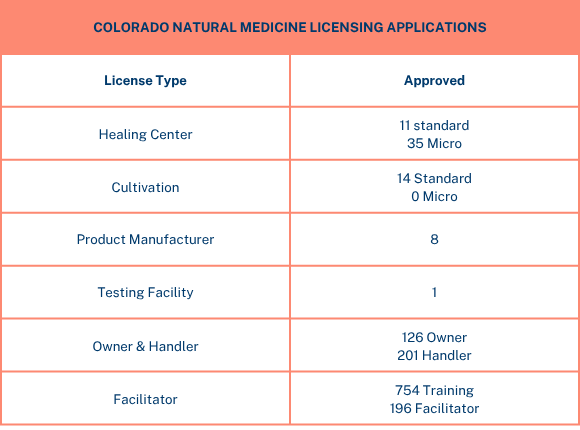
View HA's Healing Center Directory for a list of licensed healing centers in Colorado. You can also search for facilitators using DORA's licensee lookup tool.
Significant Rule Changes Considered for Natural Medicine Program
Colorado regulators have invited public comment on several proposed changes to the natural medicine program.
DORA Stakeholder Meetings
The Department of Regulatory Agencies (DORA) recently gathered feedback on a set of questions related to low dose sessions, adverse events reporting, eligibility for sessions at client homes and more. Healing Advocacy asked for changes to make low dose sessions more accessible by reducing paperwork, session lengths and required facilitator-to-participant ratios for sessions below 2mg psilocin.
DORA has now invited feedback on a new and interesting set of questions related to training requirements. The agency is considering significant changes to multiple aspects of training, from curriculum requirements to the structure of practicum and consultation and even a possible rewrite of the legacy facilitator pathway. The legacy pathway was intended to provide a more streamlined option for experienced practitioners to become licensed, but has proven extremely challenging to operationalize. DORA’s stakeholder notice suggests replacing the legacy pathway with a “limited waiver path” that would include a short “bridge module” offered by training programs and two observed administration sessions overseen by licensed facilitators. Register for the October 2 stakeholder meeting or submit written comments by Sept 29 to weigh in.
DOR Proposed Rules
In case that’s not enough to chew on, the Department of Revenue, which licenses natural medicine businesses, proposed a set of rules to implement House Bill 26-1325 (passed in May) . The proposals include a framework for temporary premises — a concept promoted by Healing Advocacy to increase access in rural Colorado and enable psilocybin experiences in closer connection with nature. Unfortunately, initial fee proposals for these temporary permits are quite high at $2,000 for a 24-hour permit or $5,000 for a 72-hour permit. Register for the Sept. 30 stakeholder meeting or submit written comments by Nov. 2 to weigh in.
> View Healing Advocacy’s Rulemaking Calendar
UPDATES: NEW MEXICO
Psilocybin Therapy Rulemaking Continues
Rulemaking continues for New Mexico’s Medical Psilocybin Program and the draft rules are available for review. Healing Advocacy is focused on recommending changes in provisions in the draft rules that we believe will unnecessarily limit access, complicate insurance coverage, drive up patient cost, and drive up administrative burden and state cost. In particular, we are recommending the following revisions:
A redesign of the program health screening, which currently requires every patient to see a DOH-permitted prescribing provider, regardless of whether they already have a qualifying diagnosis;
Removing required landlord permission for homebound patients seeking care. Draft provisions will require patients seeking care in their homes who do not own their homes to receive and submit authorization from their landlord. We believe it is inappropriate and unnecessary to require landlord authorization for tenant medical care that is already expressly authorized by state law;
Training on suicidality and challenging experiences, which are important safety topics and currently missing from the draft regulations;
Setting minimum hours for core safety topics in training, including suicidality, challenging experiences, pharmacology, trauma, and end-of-life care;
Removing the patient application process, which is a component of the medical cannabis program that is unnecessary in a supervised-use model. It presents an unnecessary barrier and delay to care and unnecessary administrative burden that will increase program costs
A public hearing on the draft rules will be held on Friday, October 2, 2026, at 9:00 a.m. in the Harold Runnels Building auditorium in Santa Fe, New Mexico.
Written public comment on the proposed rule may be submitted by email to Jacob Clark at jacob.clark@doh.nm.gov, or by U.S. postal mail to:
Jacob Clark
NMDOH OGC
P.O. Box 26110
1190 St. Francis Dr., Suite N-4095
Santa Fe, NM 87502-6110
Written comments must be received by the close of the public hearing on October 2.
First Psilocybin Cultivator Licensed
The first psilocybin cultivator — Sacred Alto Spores — has been licensed in the New Mexico state program. Healing Advocacy is excited to celebrate this important milestone, as a healthy cultivator ecosystem is a key component of a successful state psilocybin program.
UPDATES: OREGON
Up to Date Numbers on Psilocybin Services Program Licensing
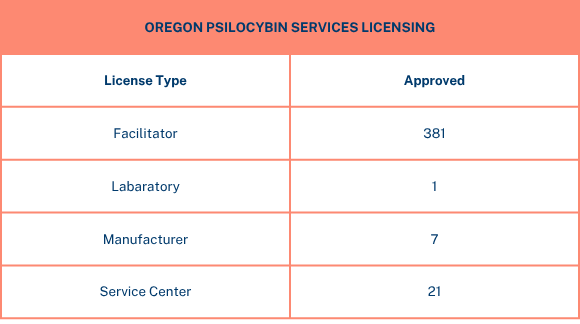
View the Oregon Psilocybin Services Data Dashboard to see the most up-to-date numbers.
A Victory for Regulated Psilocybin Services
This week, the Oregon program got a major win: the Oregon Health Authority announced it will not move forward with the rulemaking process that would have doubled license fees for facilitators, service centers, and manufacturers. After sustained public comment, testimony before the Oregon Psilocybin Advisory Board and rule advisory committees, and pressure from advocates and impacted businesses, OHA confirmed it will not adopt final rules through this particular process. A new rulemaking effort (unrelated to fee changes) is expected to open for public comment this December.
This outcome didn't happen by accident. It happened because of the psilocybin therapy community. For example, Healing Advocacy's ask to the community generated almost 700 emails to the Governor's office and the OHA Director, helping open doors that had been closed and leading to substantive conversations about budget transparency and the real financial impact of these fee hikes. Testimony to the House Behavioral Health Committee helped inform legislators of the fee increase impacts. Public records work armed peopled with valuable facts. The Oregon Psilocybin Advisory Board and the people serving on OPS’ Rules Advisory Committees did valuable work. Behind the scenes, the Healing Advocacy team steadily worked these same channels, engaging directly with the Governor's office and legislators to press for a hold on fee increases and greater accountability.
This week, the sum of all the grassroots pressure resulted in real policy change. While the fight for a right-sized, sustainable program will continue, the community has now seen what collective advocacy can accomplish to protect access to this groundbreaking and needed therapy.
The Research is In
In August, over 150 researchers, practitioners, policymakers and community advocates met to examine the breakthroughs and dig into three years of data from Oregon’s groundbreaking psilocybin therapy program. The Oregon Psychedelic Innovation Summit was hosted at Oregon Health Science University (OHSU), and co-sponsored by OHSU’s Open Psychedelic Evaluation Nexus (OPEN) and Healing Advocacy, summit presenters offered recaps of translational studies; clinical trials; pilot studies of specific mental & behavioral health conditions; and early real-world outcomes drawn from client research in the emerging program.
> Read about the research presented at the summit
EVENTS
Webinar Recording: Can Natural and Synthetic Psychedelic Medicines Coexist?
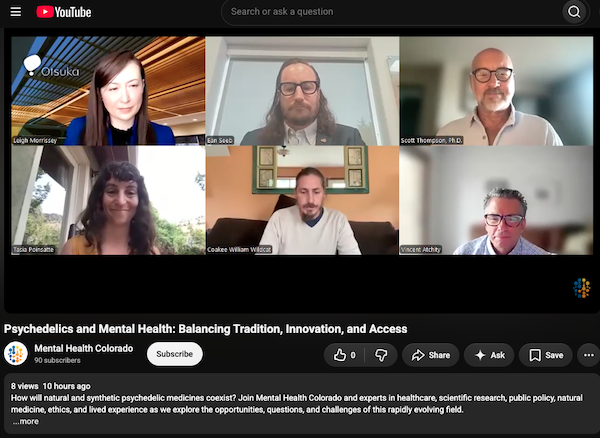
Psychedelic medicines are at the center of one of the most important emerging conversations in mental health. Naturally occurring psychedelics like psilocybin have been used for millennia in traditional and indigenous healing. Today they are being studied for depression, PTSD, and substance use disorders, while pharmaceutical companies develop synthetic versions.
On September 23, Mental Health Colorado hosted a panel of experts in healthcare, research, public policy, natural medicine, ethics, and lived experience. Panelists (including Healing Advocacy Colorado Director Tasia Poinsatte) explored how natural medicine, traditional practices, and FDA-approved therapies might coexist. They discussed commercialization and equity, respect for the cultural origins of these medicines, and Colorado's evolving Natural Medicine program.
The conversation wasn't a debate about choosing one approach over another. It was a balanced look at how to make emerging care safe, ethical, accessible, and culturally respectful.
> Watch the webinar
Feature film debut in Oregon: "Peaking: Psychedelics and the Pursuit of Happiness"
A new feature documentary, Peaking: Psychedelics and the Pursuit of Happiness, opens in Portland, Oregon tonight at Cinema 21 Theater. Directed by Jordan Kronick, the 95-minute film takes viewers directly through the experience of pro athletes recovering from brain injuries, combat veterans easing suicidal despair and a woman breaking free from opioid addiction from start to finish.
The film features MAPS founder Rick Doblin, leading psychedelic researcher Robin Carhart-Harris, NHL player and Stanley Cup champion Daniel Carcillo, and Heroic Hearts Project founder Jesse Gould. Prior to the Thursday preview, an expert panel and Q&A includes director Kronick and NHL star Carcillo. The film rolls out in other cities — including Los Angeles and New York — over the next few weeks. To buy tickets, visit the link below.
COMMUNITY SPOTLIGHT
Mikki Vogt: Bridging the Sacred and the Scientific
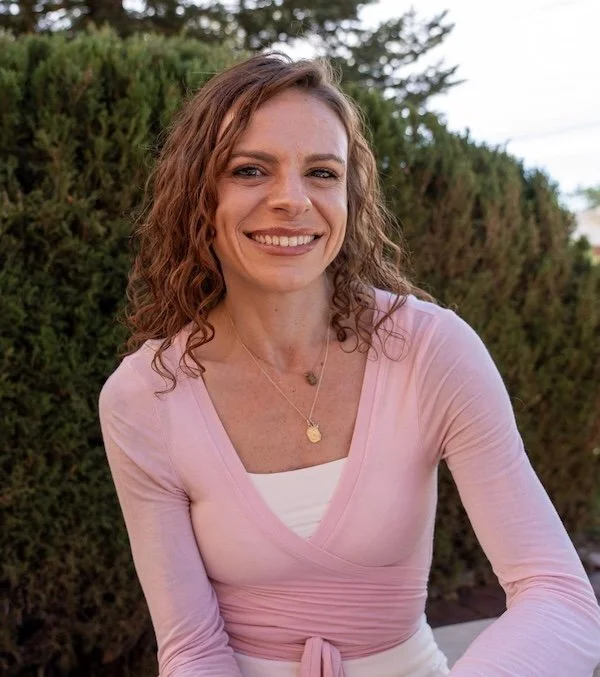
A licensed therapist, addictions counselor, and clinical supervisor, Mikki Vogt is co-founder and Clinical Director of NeuroAlchemy, a licensed healing center and facilitator training organization in Colorado. She has helped shape the state's regulated natural medicine landscape and co-founded the state's first licensed healing center, and now trains facilitators. Mikki was recently a guest on the podcast “Unbehaved” and this month, was invited to give testimony at an FDA hearing on psychedelics.
You have a client who suffered multiple debilitating seizures every day for years, and who was helped by psilocybin therapy. Without revealing personal details, can you tell us about it?
This client was a healthy, well-adjusted kid until age 11, when he contracted a brain infection on a family trip abroad. Unfortunately, he began having multiple severe seizures a day after he came home, which upended his life. Doctors couldn't agree on where in the brain the seizures originated, and rather than proceed conservatively, between the ages of 11 and 13 he went through three brain resections and five depth probes. The seizures got worse, and his cognitive functioning plummeted. For the next 17 years he had several debilitating seizures a day, often lasting 10 to 15 minutes. He couldn't finish school or live on his own.
Thankfully his neurologist had been reading about psilocybin and called me. We spent three or four months building safety and emergency protocols before administration day. On administration day, his mother was on site with one of my colleagues in case emergency medication was needed; the instruction was to administer the medication if a seizure went past five minutes. An hour in, on a moderate dose, he was smiling and laughing, which was amazing as this was someone who hadn't experienced joy for many years. A few minutes after we gave him a small booster, his body started to seize. Right before it happened, he had said to me, "It's as though I can see a form pushing the seizure toward my body." Thirteen seconds later, the seizure stopped on its own and my client said, "I can push back against the form and push the seizure away." He dropped back in and for the remaining hours, he didn't have another one. By the end of the day, his left hand, which had been painfully curled for years, had relaxed. He looked at me and said, “Oh my god, I'm using my hand.”
Between that session and the next one, three and a half months later, he had just one seizure, brought on by overheating in a sauna at the gym -- just one. His neurologist said, “I can't explain that, but we need to keep doing it.” He's now moved from not being able to attend school to being in a coding program. He's teaching art classes. None of that was possible before. This is one person's story, and while I can’t guarantee it for anyone else—I also have no reason to believe it wouldn't help others either.
You've talked about bridging the sacred and the scientific in this work. What does that look like, and how do you bring the sacred into your practice?
My client’s story is a good example. In integration, I asked him to draw the form he'd seen pushing the seizure toward him. He described it as an ancient golden sphere, and the drawing he made was covered in what looked like markings. We built an imagery practice around it: when he feels the signs that a seizure is coming, he imagines that form and pushes back against it, physically and energetically. I later spoke to a healer who said it sounded like energy he'd been carrying since that overseas trip, and that now that he could see it, he could push it away. Or you could say the medicine found the maladaptive wiring in his brain, created new neural connections, and prompted the brain to relearn using new parts of the network. Maybe it is both.
We want to engineer things and control them. Some of this will show up on brain imaging, and some of it we'll see in clinical trials. That's good. But there's a depth to this medicine that is beyond our understanding. It has been stewarded by ancient traditions for thousands of years.
You've described psilocybin as a tool that works well alongside other therapeutic modalities. What are some of those modalities, and what would that integrated approach to healing look like in real life?
I'm mostly talking about using those modalities during preparation and integration, which is where we strengthen and embody a greater awareness from the medicine, so it leads to durable change.
For example, bringing EMDR into integration is incredibly powerful, because there's a window of neuroplasticity after a session that we can leverage. In EMDR we reprocess a memory to move from a negative belief to a positive one, from believing something like "people will always leave" to "I know how to keep myself safe." Before psychedelics, you might work on a single target memory for six, seven, eight EMDR sessions before the new belief really takes hold. After a psilocybin session, it can take only one or two EMDR sessions, because the person is so open and receptive. The ego is far less resistant to the change. It matches what they already saw as true in their journey.
Internal Family Systems is another helpful modality for preparation and integration--I like to say psilocybin and IFS are like peanut butter and jelly, meant to work together. IFS is a psychotherapeutic system that describes the mind as being made up of various sub-personalities or “parts.” In preparation, we can use the IFS framework to prepare the “parts” of someone for the journey, so we're not steamrolling any of them; every part gets informed consent. In integration, because they've already danced with their parts during their journey, we are almost holding a roundtable with different parts of a person, hearing from them all. With psilocybin and IFS, you can finally hear the other parts that have been calling out to you the whole time, helping you move towards healing.
As we move toward FDA approval of a prescription pathway, many people worry about the possibility that the medicine will be stripped from the therapeutic container. Is healing possible without the container we see in the state programs?
Plenty of people take a lot of mushrooms and go to a concert at Red Rocks. If the molecule itself contained all the healing potential, every one of them would walk out of the concert self-actualized, changed forever, trauma left behind. Is that what's happening? No. The way I see it, the medicine opens the door. Preparation gives the experience direction. The therapeutic relationship creates the safety of the container, so you can go deep. And integration gives it durability. Integration is where you choose to walk through the door and turn insight into embodied change. Otherwise, the insight just fades as the noise of life comes back in.
We talk about set and setting as the two most profound factors in outcomes, and the facilitator is part of the setting. And there's something even more basic underneath that. Every human wants to know their existence matters. Bearing sacred witness as a facilitator to someone exploring their internal world, battling their distress and stepping beyond the veil says clearly: your effort means something. You are inherently worthy of being seen. Today, there's rarely any other experience where that's the reality.
Why is psilocybin therapy effective at changing deep-seated beliefs, the ones people may work on for years in talk therapy, but that sometimes persist?
From a neurocognitive standpoint, psilocybin quiets the default mode network, which is where we hold our most rigid beliefs and neural pathways. I call it the area of the ego; where you hold limiting beliefs like "I believe I have to please others to earn love." Those beliefs come from years of experiences, and once they take hold, we go looking for confirmation of what we have already decided is true.
Psilocybin disrupts that. It creates a kind of entropy in the brain, and while the default mode network is quiet, other regions start talking to each other. Instead of seeing your life through the same old lens, you see it from novel angles. People say, “Oh, now I see. Why was I telling myself that?”
What matters is that the awareness isn't coming from someone else. In talk therapy, people rationally understand that they are smart and lovable and kind but still have the felt sense of being less than, of being inadequate. Overcoming that kind of embodied learning with cognitive insight does not always work. In a psilocybin session, you get the same kind of embodied, experiential learning that built the old belief system in the first place, and are able to incorporate a new belief system. You experience what it feels like to believe you're worthy.
It doesn't erase the old belief. What it does is give you a choice about what to believe. In integration, we support the person in choosing that new path repeatedly, so it becomes more familiar and the old one isn't as easy to access. We're no longer at the mercy of a maladaptive belief system. We have given agency back by connecting someone with their own inner healing wisdom.
IN THE NEWS
Psychedelics Get a Hearing at the FDA
NPR
The Trump administration has signaled it's behind the psychedelic renaissance, but there are still big questions about how these drugs will be administered once they are approved by the FDA.
> Listen to the full story
‘Unparalleled’ study finds psilocybin protects against nerve damage from chemotherapy
Scientific American
Chemotherapy is brutal. The cancer treatment is often lifesaving, but it comes with serious side effects. Some are shorter-lived, such as hair loss, nausea and fatigue, but others can last long after treatment is over and even for life. That’s the case with peripheral neuropathy. This painful side effect, which can cause tingling and numbness in the hands and feet, can be managed with ice and painkillers or opioids. But for the most part, it is unpreventable. That could soon change: New research in mice suggests psilocybin, an active ingredient in magic mushrooms, may protect against this kind of severe nerve pain.
> Read the full story
Oregon Regulators Nix Higher Fees for Psilocybin After Industry Backlash
Oregon Capital Chronicle
State regulators have backed off pursuing sizable fee increases on Oregon’s magic mushroom businesses after dire warnings from the legal psilocybin industry that it would buckle under the added costs. The Oregon Health Authority announced Tuesday that it would not adopt proposed rules that would have doubled the annual licensing fees for businesses across the psilocybin supply chain while eliminating discounts for veterans and low-income people.
> Read the full story